
August 29, 1999 – Round 22 of the AFL season
The day after Collingwood farewelled Victoria Park after 107 years by winning the wooden spoon, Hawthorn played the Sydney Swans in what was the 732nd and last game to be played at the fabled ground known as Arctic Park, and despite being out of the finals hunt and the Swans having a chance of a Top 5 finish, the Hawks won by 85 points in front of 72,130 people, a grand farewell to the ground that had served as the Hawks’ home ground in the ’90s (As it had been for St Kilda), and became the Hawks’ administration and training base during the mid-2000s.
Nathan Thompson kicked 6 goals and was voted best afield, Nick ‘Dutchy’ Holland kicked 5 and got the 2 votes, while Joel Smith got 1 vote playing out of the backline.
It was a rather quiet way to see off a venue that served as a monument to shattered dreams and a reminder of the VFL’s delusions of grandeur, having once been destined to hold somewhere close to 166,648 fans (Or 157,000 depending on who you ask), dwarfing the Melbourne Cricket Ground as part of the VFL’s war with the Melbourne Cricket Club, with a state-of-the-art sepia video screen for Instant Replay, one of the first screens at an Australian sporting stadium, and a new train line on the way to what is the geographical centre of Melbourne with a bus terminal as well…
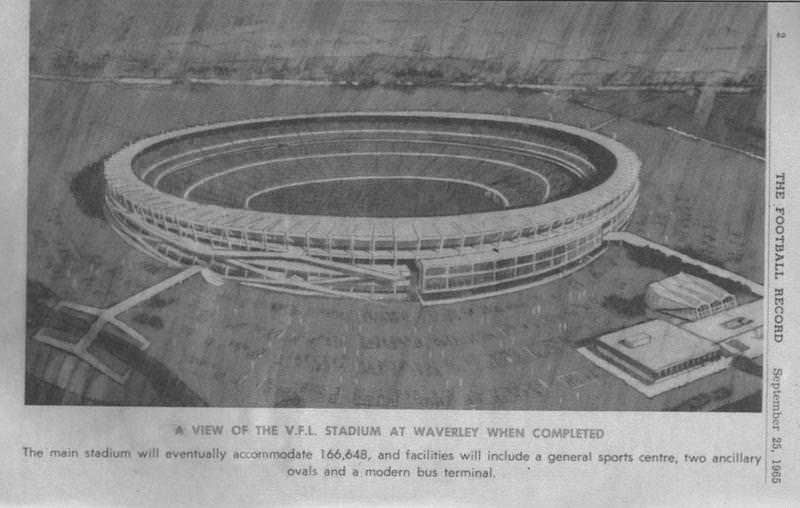
Alas, the crowd only got to a maximum of 92,000, all of it wooden benched seating, the exposed weather site earned it the nickname Arctic Park, the train line never happened, the buses weren’t much better, and all it had to service fans was one of the world’s most notorious carparks, with the poor access roads creating congestion so bad that families resorted to cannibalism as they waited hours, followed by days, to get on to the Monash Freeway.
Still, it wasn’t all the VFL’s fault, because the original plan to develop the capacity to 166,000 was ruined by successive Victorian governments, and the next plan was to have the ground developed to hold 104,000 patrons in time to host the 1985 Grand Final, upgrade plans that were kyboshed by John Cain’s state government not wanting to move the Grand Final from the MCG…
By sheer coincidence, John Cain was an MCC member who granted funding for the MCG’s floodlights, and later sat on the MCG Trust.
Eventually, the AFL’s decision to help fund construction of the Great Southern Stand at the MCG in the early 1990s (Which improved relations with the MCC), followed by construction of the much more central Docklands Stadium in the late 1990s, heralded the end of the former VFL Park, which left dilapidated until it was eventually sold off by the AFL to Mirvac for $110m in 2001, with the carparks and every stand bar the Sir Kenneth Luke Stand being demolished to make may for housing development, with Hawthorn later moving into the refurbished ground in 2006.
Still, Waverley/VFL Park had some historic milestones:
When it opened in April 1970 (Albeit it was half-finished) for the Fitzroy vs Geelong game, it was the first sporting ground in Australia to be designed and built specifically for Australian Rules Football (Football Park in Adelaide followed suit in 1973).
– At 200m long by 160m wide, it was by far the biggest ground in the VFL/AFL, although by the end of its tenure the league only used 182 m x 142 m – For reference, the MCG is 160 metres x 141 metres, and Docklands/Marvel is 160 m × 129 m.
– It hosted the first Elimination Final in league history in 1972, in which St Kilda defeated Essendon by 53 points, beginning Essendon’s nightmare history in Elimination Finals.
– The Hawthorn-Collingwood game on the Queen’s Birthday in 1981, which recorded a crowd of 92,935, is the only game in league history to record a crowd of 80,000+ patrons outside of the MCG.
– Waverley was also the first venue to host a World Series Cricket match (The Supertest of 1977), and it was the first venue in the known world to host an international day/night cricket match, although World Series matches aren’t recognised by the ICC, so the first official floodlit One Day International is the Australia vs West Indies match at the SCG in November 1979.
– It hosted the 1991 AFL Grand Final due to the aforementioned construction of the Great Southern Stand at the MCG, and prior to the recent Pandemic it was the only time in a 75-year span after WWII that the Grand Final hadn’t been held at the MCG… it was also a historic moment for the game, given the West Coast Eagles became the first non-Victorian team to appear in a Grand Final.
Not many people remember that, thanks to Angry Anderson’s Batmobile.
– Waverley’s location in the middle of a rain belt, giving it the aforementioned Arctic Park nickname, was perhaps best displayed in Round 11 of 1993, when St Kilda and the Brisbane Bears went from playing in light rain to being bombarded by hail stones during the 2nd Quarter, leading Sandy Roberts to comment that “I’m not exaggerating, but I don’t think we’re all that far away from snow here, you know.”… The hail stopped, and the Saints won by 55 points in a game featuring 11 goals to Tony Lockett.
– The St Kilda-Essendon game of Round 10 1996 featured one of the finer moments in league history, as the power went out at the ground during the 3rd Quarter when a car slammed into a nearby transmission tower, creating scenes reminiscent of Lord of the Flies – It led to the AFL finally deciding on contingency rules for abandoning games.
– Round 22 of 1999 was the last official AFL game at Waverley, but it wasn’t the last Australian Rules game at the venue, with Waverley still hosting games for the 2000 pre-season Ansett Cup, including both Semi Finals, while there was an unofficial practice game between St Kilda and Richmond held a week before the season began (The last game between two AFL teams at Waverley)…
And the last official game at Waverley was the 2000 VFL Grand Final between Sandringham and North Ballarat, which Sandringham won by 31 points in front a meagre crowd of 8,652… most of them didn’t have the presence of mind to steal the benches they were sitting on.
Fun fact – When Mirvac did the development of the land, most of the streets surrounding the ground were named after famous sporting grounds:
– Croke Park
– Selhurst Park
– Anfield
– St James’ Park
– Lord’s
– Trent Bridge
– Edgbaston
– Windy Hill
– Ellis Park
Categories: AFL
 JT's Sporting Reviews